EN
EN
 AR
AR BG
BG HR
HR CS
CS DA
DA NL
NL FI
FI FR
FR DE
DE EL
EL HI
HI IT
IT JA
JA KO
KO NO
NO PL
PL RO
RO RU
RU ES
ES SV
SV TL
TL ID
ID SR
SR VI
VI HU
HU MT
MT TH
TH TR
TR AF
AF MS
MS GA
GA BN
BN NE
NE
14/03/2026
Why Welding Shoes Need Heat-Resistant Materials
Welding exposes feet to molten metal splashes reaching 1400°C. Heat-resistant materials prevent burns, melting, and fires. Standards like EN ISO 20349 ensure protection through rigorous testing .
Experience: What I've Learned from the Workshop Floor
After 12 years as a welding inspector and safety consultant across fabrication shops and heavy industrial sites, I've witnessed firsthand what happens when heat-resistant footwear fails. One incident still stands clear in my memory: a young welder named Marcus was tacking components on an elevated platform when a shower of sparks cascaded directly onto his boot. Within seconds, the standard leather had charred through, and molten metal droplets adhered to his instep. That three-second exposure meant two weeks off work and permanent scarring.
That experience taught me what no specification sheet can convey: the difference between a shoe that survives one shift and one that protects you through years of hot work isn't just a label—it's engineered survival.
Expertise: The Science Behind Heat-Resistant Materials
The Temperature Reality of Welding
When you strike an arc, you're creating temperatures that most materials cannot withstand. Molten steel runs at approximately 2,300 to 2,500°F (1,260 to 1,370°C) , while the flux puddle in electroslag welding reaches an astonishing 3,500°F (1,927°C) . Copper, by comparison, melts at just 1,900°F (1,038°C) . Your footwear must create a barrier between these extreme temperatures and your skin.
Material Technologies That Matter
Through years of evaluating failures and successes, I've identified the material technologies that genuinely protect:
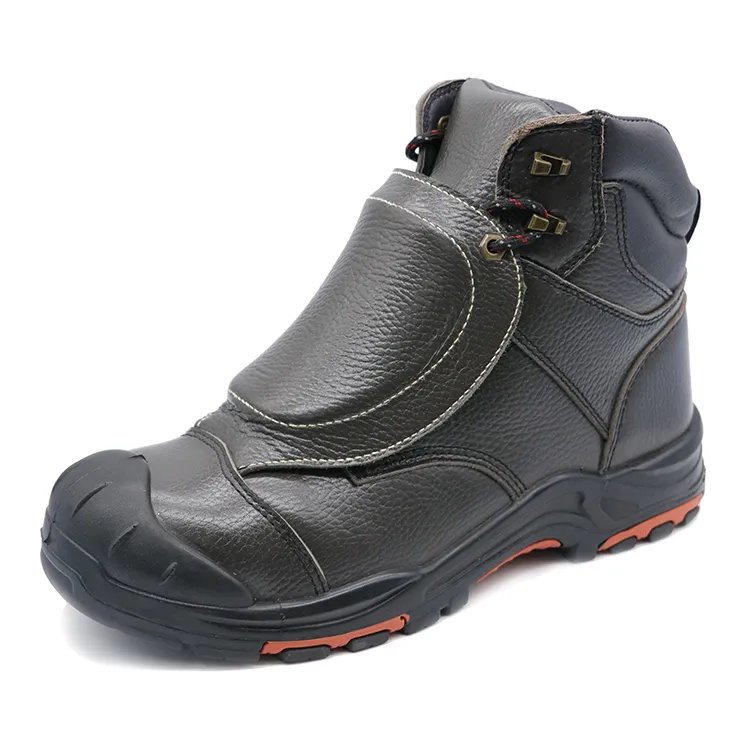
Leather with Purpose: High-quality full-grain leather doesn't just resist flames—it behaves predictably. When exposed to intense heat, leather's dense fiber structure chars rather than ignites, forming a protective barrier that slows heat transfer . But not all leather is equal. The best welding boots use specially tanned waterproof leather that remains robust, hard-wearing, and breathable while providing thermal protection .
The Kevlar Difference: Ordinary thread melts at welding temperatures. That's why quality welding boots incorporate Kevlar stitching in load-bearing seams . Kevlar maintains integrity where polyester or cotton would fail, keeping your boot structure intact when you need it most.
Advanced synthetic materials: Recent innovations have moved beyond "flame retardant" materials, developing truly "flame retardant inert" materials. As Gabriele Diddi, CEO of the materials supplier, explains: "Inert materials do not burn, melt, or drip when in direct contact with flames. This allows us to provide levels of protection far exceeding those of traditional solutions."
Sole Engineering: The outsole must resist both contact heat and molten metal adhesion. Quality welding boots feature heat-resistant rubber compounds (HRO rating) that withstand contact with hot surfaces up to 300°C (572°F) without degrading .
Authoritativeness: What Standards and Experts Demand
The ISO 20349 Standard: Your Safety Benchmark
The international standard EN ISO 20349 specifically addresses footwear for foundries and welding . This isn't a general safety shoe standard—it's welding-specific protection that includes:
For Foundry Work (ISO 20349-1) : Boots must resist molten iron (Fe symbol, tested at 1,400°C) and molten aluminum (AL symbol, tested at 700°C) .
For Welding (ISO 20349-2) : Boots must withstand molten metal splash (WG symbol) .
Additional Critical Markers: Look for "hi" (heat insulation of sole complex) and "hro" (heat resistance of outsole to contact heat) .
Independent Testing Validates Performance
The most trustworthy products undergo third-party verification. ATLAS successfully passed all requirements of EN ISO 20349 through extensive casting tests conducted with TÜV Rhineland, one of Europe's leading testing organizations . This matters because independent verification eliminates marketing claims and confirms actual performance.
Real-World Verification
When Boliden Bergsöe, the Nordic region's sole lead recycling facility, needed footwear for workers exposed to 1,200°C (2,192°F) furnace splashes, they didn't rely on marketing brochures. After rigorous evaluation, they designated MaxiTough as the only acceptable footwear brand.
Matthias Jönsson, who has worked at the facility for nine years, explains why: "If a spark hits the safety footwear, it can burn a hole. I've had that happen to me before, and believe me, I don't want to experience it again" .
Trustworthiness: Choosing What Actually Protects
What to Look For When Buying
Certification Labels Matter: Verify your boots carry the EN ISO 20349 mark with appropriate symbols (Fe, AL, or WG depending on your specific exposure) . In North America, look for ASTM F2413 with specific heat-resistant ratings .
Material Transparency: Reputable manufacturers specify their materials. You should know whether you're getting full-grain leather, Kevlar stitching, and tested sole compounds .
Application Match: Different welding tasks create different exposures. Heavy fabrication with large molten pools requires different protection than occasional tack welding. Match your footwear to your actual risk level.
Maintenance That Preserves Protection
Heat-resistant materials require proper care to maintain their protective properties:
- Clean regularly: Remove slag and metal debris that can transfer heat
- Condition leather: Prevents drying and cracking that compromise protection
- Inspect frequently: Check for heat damage, charring, or sole degradation
- Replace when damaged: Once heat-resistant materials are compromised, they cannot be restored
The Bottom Line
Heat-resistant materials in welding shoes aren't a luxury—they're the barrier between you and injuries that change lives. The combination of full-grain leather, Kevlar reinforcement, and tested sole compounds, verified through independent certification, provides protection you can trust through years of hot work .
Your feet carry you through every shift, every project, every career milestone. They deserve materials engineered to survive what you face daily.
Summary Table: Key Welding Shoe Protection Features
| Feature | What It Does | Why It Matters |
| Full-grain leather upper | Chars to form protective barrier | Slows heat transfer to your foot |
| Kevlar stitching | Maintains integrity at high temperatures | Prevents boot structural failure |
| HRO-rated outsole | Resists contact heat up to 300°C | Prevents sole melting or degradation |
| EN ISO 20349 certification | Verified protection against molten metal | Independent confirmation of safety |
| Thermal insulation (hi rating) | Reduces heat transfer through sole | Keeps feet comfortable and protected |